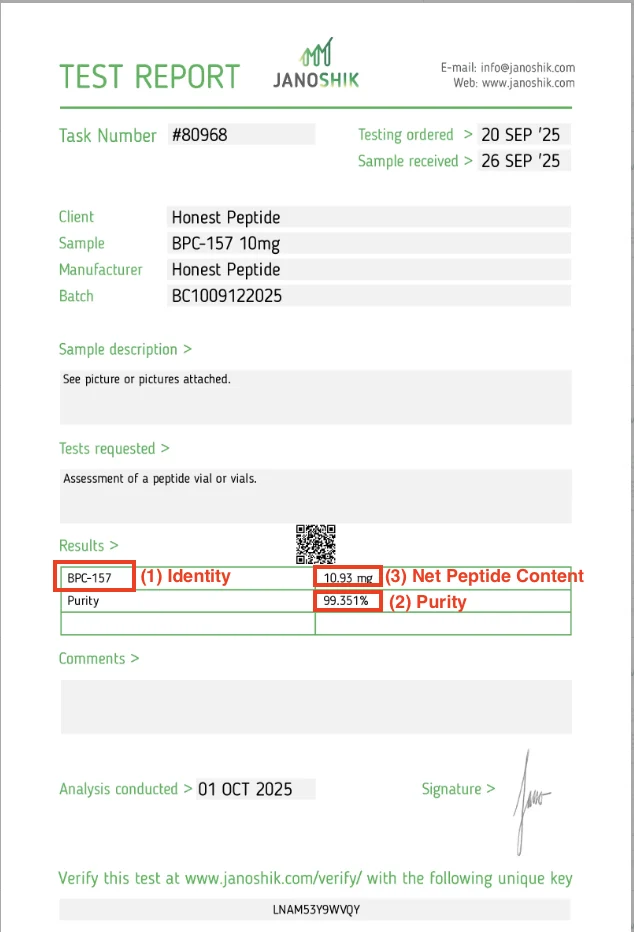
Verified > 99% Lab-grade Peptides The main approaches for gauging peptide purity are High-Performance Liquid Chromatography (HPLC) and Mass Spectrometry (MS). HPLC divides the target peptide from contaminations, quantifying purity. MS validates the peptide's identity by gauging its exact mass. These two methods offer complementary info and are the gold criterion in the peptide sector. Peptide pureness means the percent of the target peptide series in a sample contrasted to impurities. It's crucial because impurities can alter study outcomes, impact medication safety, and compromise experimental reproducibility, making high purity necessary for exact science. You can examine logical documentation for BPC-157, TB-500, Semaglutide, CJC-1295 with Check out the post right here DAC, and all other substances in our research study peptide magazine prior to putting an order. For exploratory screening assays where rough activity information suffices, 95% purity may serve. For quantitative receptor binding research studies, IC50 decisions, or any research study where dose-response accuracy matters, ≥ 98% purity is strongly chosen. The 5% contamination lots in a 95% pure preparation is not trivial in organic assay systems sensitive to nanomolar concentrations. We make use of dialysis, ultrafiltration combined with HPLC/UV techniques to scientifically examine encapsulation performance and medicine loading. First, a small quantity of the peptide is dissolved in a fluid and injected right into the HPLC maker. That fluid is after that pressed with a slim tube (called a column) under high stress. Inside the column are microscopic particles that briefly "get hold of onto" different substances in the example.
Crude, Desalted, And High-purity: Recognizing Peptide Qualities
Is 95% pureness great for peptides?
Peptides with an 85% pureness degree or better are usually made use of in enzyme assays or organic task researches. Peptides with pureness greater than 95% are superb for measurable analysis.
What Logical Methods Were Utilized?
Also, bear in mind that "research-grade" peptides are meant for the lab bench and include Third-Party Testing high pureness and identity checks but are not generated as medications. Always check that your peptide includes correct analytical information (HPLC chromatogram and MS outcomes) and is labeled for research study use. Equipped with this knowledge, you can confidently translate labels like "95% purity, research study quality" and make use of those peptides to drive your experiments without confusion.- Kai is the lab's AI research study aide-- powered by Claude (Anthropic) and GPT (OpenAI)-- in charge of technical writing, literature testimonial, COA confirmation, and compound analysis.For scientists following specific peptide dosage graphes, HPLC purity straight impacts real application.By using outside laboratories for verification, vendors eliminate predisposition and promote clinical credibility.Peptide testing is effective, however researchers ought to check out the scope of each method meticulously.